Piecewise Function Continuous Calculator . Fourier series (in common there are piecewises for calculating a series in. Check in the first two parts of the function. calculus Derivative of piecewise functions Mathematics Stack Exchange from math.stackexchange.com Here we are going to check the continuity between 0 and π/2. For the values of x lesser than or equal to π/4, we have to choose the function sin x. We can check this using $3$ conditions:
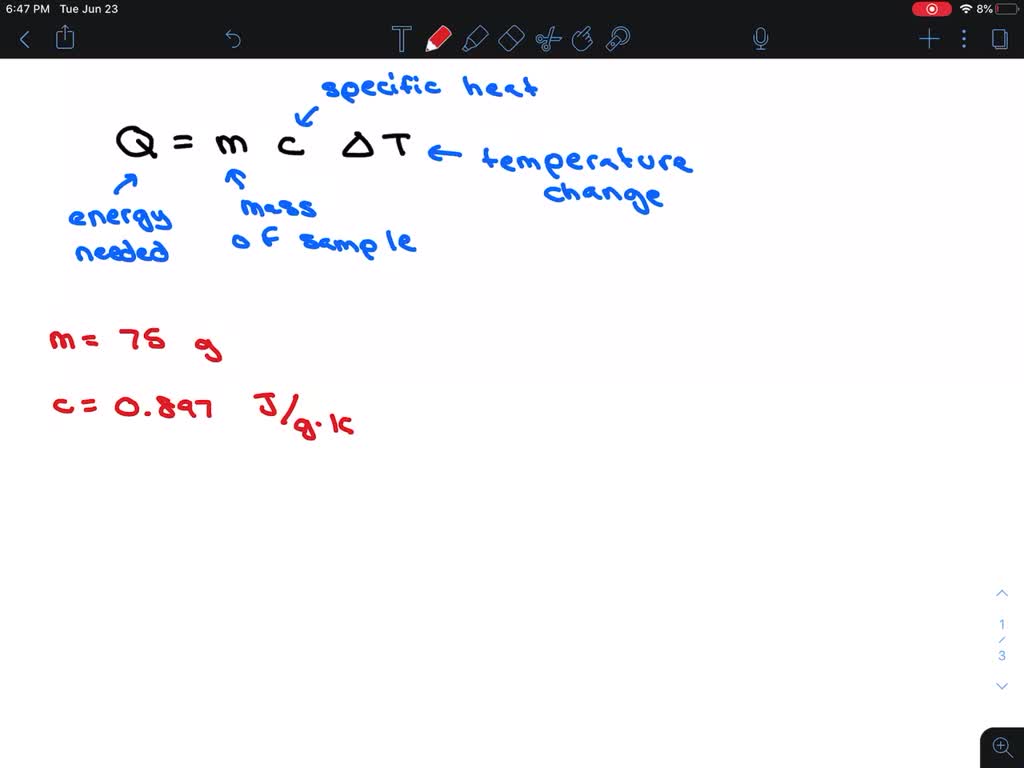
Calculating Molar Heat Capacity. C p = specific heat capacity. The heat capacity of 1 gram of a substance is called its specific heat capacity (or specific heat), while the heat capacity of 1 mole of a substance is called its molar heat capacity.
Use the molar heat capacity for aluminum from tab… from www.numerade.com
Molar specific heat capacity ( c ) = 1µ δ q δ t. Molar heat capacity (c n) this is the amount of heat required to raise a substance or material by one unit amount of substance and one unit of temperature. N = amount of substance;
A Metal Piece Of 50 G Specific Heat 0.6 Cal/G°C Initially At 120°C Is Dropped In 1.6 Kg Of Water At 25°C.
About press copyright contact us creators advertise developers terms privacy policy & safety how youtube works test new features press copyright contact us creators. C p = molar heat capacity. The formula used by this calculator to determine the molar heat capacity from the heat capacity and amount of substance is:
Molar Specific Heat Capacity Is The Specific Heat Capacity Of A Gas That Is Held Under Constant Pressure Or Volume.
Amount of substance (v) this is the total number of particles in the substance. If (cm) is the molar heat capacity, (n) is the number of moles of the substance, (at) is the temperature change, then the quantity of heat absorbed or released (q) can be calculated using the relation: C n = molar heat capacity;
Molar Heat Capacity Of Water = (4.1813 Joule/Gm K) X (18 Gm/Mol) = 75.2634 Joule/Mol K Calculating This Parameter For Any Element Is An Experiment Which You Will Surely Perform As A Part Of Your First Chemistry Lab Course.
The units of mass or volume don’t matter, as long as they. For example, the molar mass of water is ≈ 0.018 k g / m o l. Determine the heat capacity of 3000 j of heat is used to heat the iron rod of mass 10 kg from 20oc to 40oc.
Multiply The Specific Heat By The Molar Mass To Get The Molar Specific Heat.
So the molar specific heat of water is 4186 j / ( k ⋅ k g) × 0.018 k g / m o l ≈ 75 j / ( k ⋅ m o l) share. The heat capacity of a mixture can be calculated using the rule of mixtures. Heat capacity (c) this is the amount of thermal energy required to raise a substance or material by one unit of temperature.
The Units Of Molar Heat Capacity Are:
The specific heat capacity can be calculated from the molar heat capacity, and vise versa: Generally the most constant parameter is notably the volumetric heat capacity (at least for solids) which is around the value of 3 megajoule per cubic meter per kelvin: It is expressed as c p or c v respectively.


Comments
Post a Comment